
A Personal Self-Assessment for Pastoral Wholeness
Is this you?
You became a pastor because something called you, not because you had a leadership development plan or a management philosophy. And for a season, that calling was enough to carry you through the hard days.
But somewhere along the way, the weight accumulated. The staff meeting that ends with more tension than clarity. The initiative your whole team agreed on that nobody seems to be moving toward. The gifted team member you genuinely care for who keeps underperforming — and the quiet confusion of not knowing whether to press harder, step back, or change strategy entirely. The congregation that loves you but hasn’t changed direction in years.
You are not failing. You are not faithless. But you may be stuck. And you can sense the distance between the pastor you know you are called to be and the one who shows up on Monday morning.
Here is what most pastoral leadership frameworks miss: the problem is rarely a lack of commitment, character, or competence. The problem is almost always an imbalance — a default orientation that serves you well in some situations and costs you dearly in others, often beneath your own awareness.
The Threefold Calling is a framework designed to help pastors and church leaders to move toward balance: move from exhausted effort in every direction toward integrated, purposeful leadership from a whole self.
The Framework
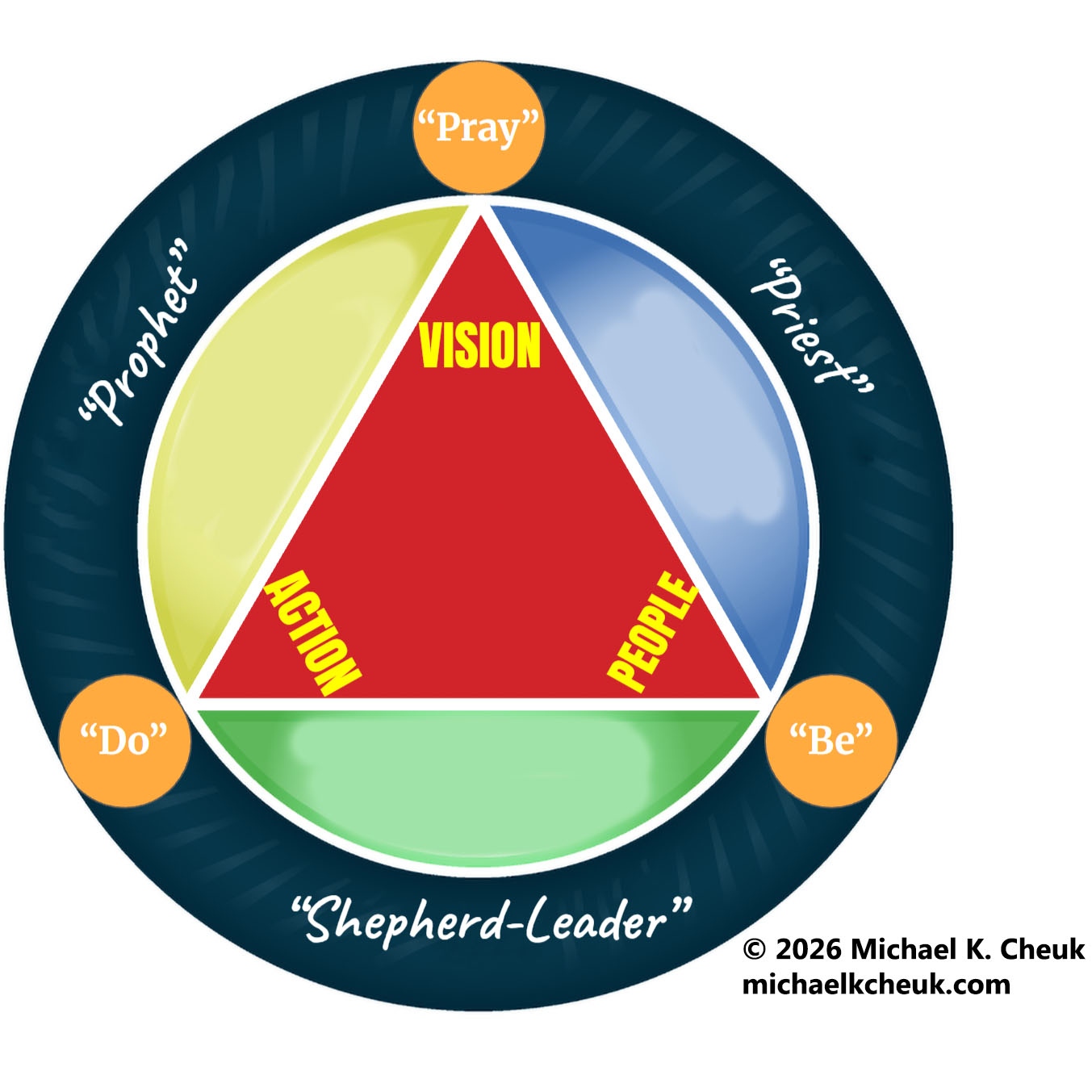
At its core, The Threefold Calling is built on a simple but theologically grounded premise: effective pastoral leadership requires sustained, integrated attention to three fundamental dimensions in vertexes of a triangle: Vision, Action, and People. Most pastors have a default: a dimension they inhabit naturally and lean on consistently. Most pastors also have a gap: a dimension that fades under pressure and costs them, and the people they lead, more than they realize.
The framework maps three biblical callings — Prophet, Priest, and Shepherd-Leader — onto the edges of the triangle, each holding two dimensions in productive tension. It also connects each dimension to a spiritual posture — Pray, Do, and Be — that sustains it. The goal is not equal mastery of all three dimensions. The goal is integration: knowing your default, understanding what it costs you, and leading from an increasingly whole self.
- VISION — Pray. The capacity to sense God’s direction, articulate a compelling future, and orient your community toward what matters most. Sustained by the spiritual posture of Prayer — seeking, receptive, listening.
- ACTION — Do. The capacity to make decisions, build systems, execute plans, and move people from intention to impact. Animated by the spiritual posture of Doing — courageous, structured, and decisive.
- PEOPLE — Be. The capacity to build genuine trust, tend relational health, care for individuals, and create community. Expressed in the spiritual posture of Being — unhurried, attentive, present.
The three callings
Each biblical calling spans two dimensions — holding them in productive tension rather than collapsing into one:
| Prophet | Vision + Action. The Prophet sees the just future and moves toward it — speaking truth, embodying direction, and acting on conviction. Full of vision; compelled to proclaim and act. |
| Priest | Vision + People. The Priest mediates between the transcendent and the human — helping people see and feel the presence, care, and compassion of God. Oriented toward both vision and the people called to inhabit it. |
| Shepherd-Leader | Action + People. The Shepherd-Leader moves people through processes toward a destination — tending the flock with genuine care while exercising the authority and structure needed to actually lead somewhere. Not merely caring, but leading purposefully; not merely managing, but shepherding with intention. |
The six leadership orientations
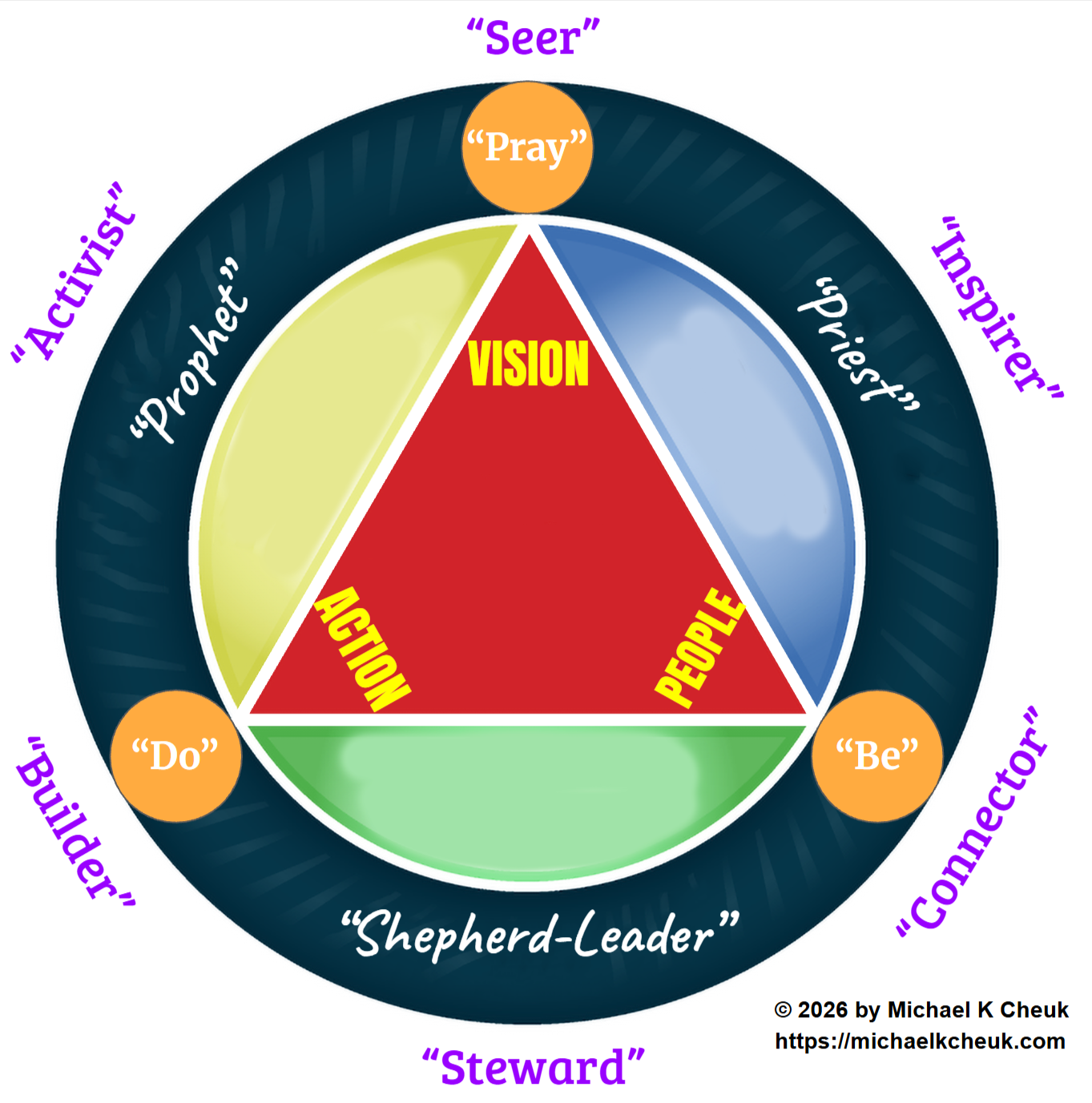
Six general leadership orientations emerge from the way these three dimensions combine in real leaders — the Seer, the Connector, the Builder, the Inspirer, the Activist, and the Steward. Each orientation reflects genuine strengths and carries a shadow side that becomes visible under pressure. The full online assessment will help you identify your natural orientation, name its strengths, and understand what integration looks like for your specific profile.
How this is connected to everything else
The Threefold Calling is the foundational framework of a broader suite of integrated pastoral leadership resources. It is designed to be the starting point because self-knowledge is what makes every other piece of the work more effective.
| Threefold Calling Assessment | Identity & Integration: Who am I as a leader? Am I leading from my whole self? |
| Called Forward Assessment | Direction & Future: Where is God calling us, and how do we get there together? |
| Called to Thrive Assessment | Strengths & Action: Where am I most effective and most alive in this work? |
| Why Conflict Starts on the Inside | Healthy Relationships: Conflict is not a problem to be eliminated but a sign that important needs are going unaddressed. |
Type your name and email address to receive the free Threefold Calling Leadership self-assessment PDF.